

Amsterdam Neighbourhoods Guide for Expats 2026 | City Retreat
James Evans • Tue, Aug 5, 2025
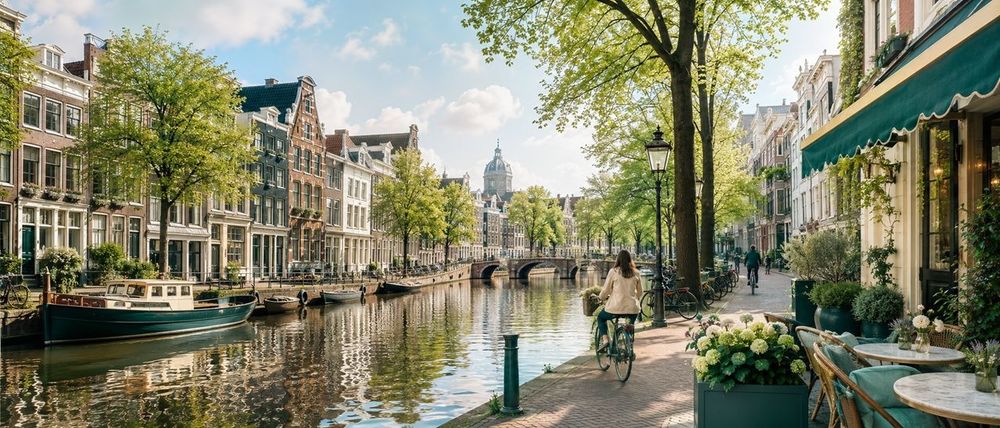
A practical guide to Amsterdam's neighbourhoods for professionals and expats — nine in-depth area guides, how rental contracts work, what BSN registration involves, and how City Retreat makes the whole process straightforward.
Looking for accommodation in Amsterdam?
Furnished apartments in nine neighbourhoods from 2 months — all-inclusive, BSN registration supported, no Dutch payslips required.
Choosing an Amsterdam Neighbourhood as an Expat or Professional
Amsterdam is a small city with strong opinions about itself — each neighbourhood has a distinct character, price level, and practical logic, and the right choice depends on where you work, how long you're staying, and what you want your evenings to look like. The good news: nowhere in Amsterdam is genuinely far from anywhere else. The metro's Noord/Zuidlijn, the tram network, and the city's bike-first design mean even the "outer" districts sit within 15–25 minutes of the centre.
For corporate professionals on assignment, the practical questions come first: commute to Zuidas or Schiphol, a registerable address for your BSN, and a home that works from day one. For expats settling longer-term, the neighbourhood choice shapes daily life more than anything else you'll decide in your first year. This guide covers both — with a dedicated in-depth guide for each of the nine neighbourhoods where we operate.
City Retreat has operated furnished serviced apartments across Amsterdam since 2012. Our expat rentals and corporate housing are available from 2 months, all-inclusive, with BSN registration supported from the first day of your tenancy.
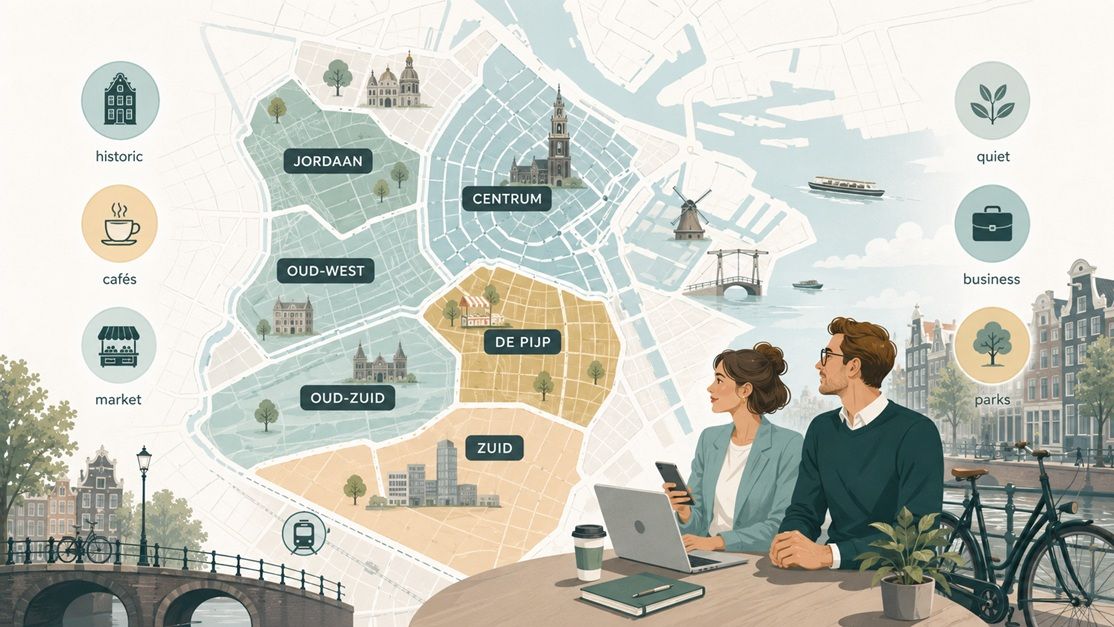
Amsterdam's Neighbourhoods — Compared for Expats
We operate in nine Amsterdam neighbourhoods, and each now has its own in-depth guide covering the area's character, commute times, housing stock, and what our tenants there actually value. The summaries below give you the shape of each; follow the links for the full picture.
Inside the Ring & the Old South
Amsterdam's most sought-after central neighbourhood: flower-named streets, hidden hofjes courtyards, brown cafés pouring since the 1600s, and a genuine community that survives the postcards. One of the city's three most expensive rental areas — and private listings vanish in days.
The UNESCO-listed canal ring — four centuries of city living with everything walkable. The tourist corridors are permanently busy, but the residential canal stretches go quiet by evening; knowing which address is which is most of the game. The tightest short-stay rules in the country make a registerable 2-month rental the workable way in.
Amsterdam's most international neighbourhood, anchored by the six-day Albert Cuypmarkt and the best-value dense food scene in the city. Metro station De Pijp put Zuidas eight minutes away, which transformed it into the default choice for young professionals who want lively over leafy.
Between the Jordaan and De Pijp in character, with the Vondelpark three minutes away and De Hallen — a 1902 tram depot turned Foodhallen, cinema and library — as its centrepiece. Municipal research once crowned it home to Amsterdam's happiest residents, and the market noticed.
Mansion apartments on leafy avenues around Museumplein, the Concertgebouw and the Vondelpark — the natural home of the executive relocation. It borders Zuidas directly, so many tenants walk or cycle to the business district, and Station Zuid puts Schiphol twenty minutes door to door. The highest average rents in the Randstad, and worth it.
The Jordaan's calmer, greener neighbour — one bridge apart, half the noise, plus an actual park. The 1885 Westergasfabriek gasworks now holds cinemas, breweries and festivals, and the Haarlemmerdijk — repeatedly voted the country's best shopping street — is the route home to Centraal, ten minutes on foot.
Beyond the Ring — Space & Value
The side of Amsterdam residents rate and visitors miss: the Javastraat's restaurant row, the six-day Dappermarkt, the Oosterpark, and the Eastern Docklands' waterfront architecture. Rents run meaningfully below De Pijp for comparable space — and Amsterdam Science Park's tech cluster is a ten-minute cycle.
Amsterdam's release valve: rents around €20/m², new-build apartments with IJ views, the NDSM shipyard's creative district, and dike villages that predate the canal ring. The distance is psychological — free ferries cross to Centraal 24/7 in minutes, and metro 52 reaches Zuidas in sixteen without a change.
Garden-city streets around the Sloterplas — a swimmable lake with beaches — and the most apartment per euro in Amsterdam, typically a third more space than the centre for the same money. Direct trains from Lelylaan reach Schiphol in eight minutes, making it the rational base for frequent flyers, project teams and relocating families.
Quick heuristics from ten thousand-plus nights of tenant feedback: working at Zuidas — choose Oud-Zuid or De Pijp; flying weekly — Nieuw-West or Oud-Zuid; maximum character — Jordaan or Westerpark; tech and Science Park — Oost; most space for the budget — Noord or Nieuw-West. Or skip the theory and use our live apartment search to filter by area and move-in date.
Beyond Amsterdam
A tenth option: Rotterdam Noord
Nine neighbourhoods above, and one outside the city. In 2026 we opened our first apartments beyond Amsterdam — three two-bedroom homes on the Bergsingel, in the Bergpolder area of Rotterdam Noord. A tree-lined street set along the water, five minutes from Blijdorp metro and a short cycle from Rotterdam Centraal.
Worth a look if your role covers the Randstad rather than Amsterdam specifically, or if the Amsterdam search is proving slow. Same terms throughout: all-inclusive, from two months, and a formal Dutch tenancy agreement supporting BRP registration from day one.
- 84–92 m²Two bedrooms, 1.5 bathrooms
- ~25 minThe Hague by direct train
- ~30 minSchiphol by direct train
- ~40 minAmsterdam by direct train
Types of Accommodation in Amsterdam
Finding accommodation in Amsterdam's competitive market is significantly harder than in most European cities. The private rental market is undersupplied, requires Dutch payslips, and typically runs on 12-month minimum leases. For most professionals and expats arriving with a specific start date, serviced apartments in Amsterdam are the most practical route.
Serviced Apartments Amsterdam
Fully furnished, all-inclusive, from 2 months. BSN registration supported. No Dutch payslips required. Move in within days of enquiring.
View serviced apartments →Corporate Housing Amsterdam
For company-sponsored relocations. Invoice billing, HR-friendly contracts, and multi-occupancy arrangements for teams and departments.
View corporate housing →Expat Rentals Amsterdam
For international professionals settling in Amsterdam. Flexible contracts, full BSN support, and no Dutch income requirements.
View expat rentals →Temporary Accommodation Amsterdam
Short to mid-term furnished rentals as a first step on arrival or while searching for a longer-term home. Registerable address, flexible exit.
View temporary accommodation →Platforms like Pararius and Funda list private rentals but almost all require Dutch payslips, a gross salary of 3–4x the monthly rent, and a 12-month minimum commitment. Popular listings in neighbourhoods like the Jordaan and Oud-West draw dozens of responses within days, and the average search runs 2–6 months. For most expats arriving on an international contract or before their Dutch employment starts, the private market is not a realistic first option. See our Amsterdam property market 2026 guide for the full picture.
What City Retreat Includes
Every City Retreat apartment — in every neighbourhood — is available on an all-inclusive monthly basis. Your single monthly price covers:
-
✓Fully furnished apartment Beds, sofas, dining furniture, storage — completely set up and ready to live in from the day you arrive.
-
✓All utilities included Gas, electricity, and water. No Dutch utility accounts to set up. See our Amsterdam energy cost guide for what these typically cost independently.
-
✓High-speed Wi-Fi (500 Mbps minimum) Pre-installed and ready from day one. No installation wait.
-
✓Weekly cleaning service Included in your monthly price. Additional or one-time cleans available on request.
-
✓BSN municipality registration supported Your tenancy agreement is a formal Dutch residential contract — the document Gemeente Amsterdam requires to register your address. Full BSN registration guide →
-
✓24/7 maintenance support Our own in-house maintenance team handles any issues during your stay, typically within 24–48 hours.
Types of Rental Contract in Amsterdam
Understanding the different contract types available in Amsterdam helps you choose the arrangement that suits your timeline and situation. Dutch rental law is tenant-protective — which means landlords and providers structure contracts carefully to reflect the nature of the arrangement.
City Retreat's standard offering. Minimum 2 months, then rolling monthly with one calendar month's notice to leave. No long-term commitment. Best suited to expats, corporate professionals, and anyone with uncertain timelines.
Standard on the private rental market. Set duration with limited flexibility to exit early. Usually requires Dutch payslips and income proof. Common for unfurnished properties on Pararius and Funda.
No fixed end date. The default under Dutch law since the 2024 Fixed-Term Tenancies Act for standard residential lets. Offers maximum stability but the least flexibility. Not typically available in the serviced apartment market.
For City Retreat's specific contract terms — including minimum stay, notice periods, and what happens if your plans change — see our flexible rental contracts guide.
How to Register at Your Amsterdam Apartment
Anyone staying in the Netherlands for more than 4 months is required to register with the municipality (Gemeente Amsterdam) in the Personal Records Database (BRP — Basisregistratie Personen). This gives you a BSN (burgerservicenummer), which you'll need for almost everything in Dutch life.
What you need a BSN for
Opening a Dutch bank account, starting employer payroll, registering for health insurance, filing a Dutch tax return, and accessing government services. Without a BSN, even basic daily life in Amsterdam is significantly more complicated.
What you need to register
A valid passport, a formal Dutch residential tenancy agreement (not a hotel booking or Airbnb), and an appointment at the Stadsloket. City Retreat provides the tenancy agreement — you book the appointment, we handle the rest of the paperwork.
Municipality registration appointments in Amsterdam typically run 4–6 weeks ahead during busy periods (particularly September–November when the new cohort of expats arrives). Book your appointment as soon as your tenancy start date is confirmed — ideally before you even arrive. Full step-by-step instructions in our Amsterdam registration and BSN guide.
For shorter stays (under 4 months), you can register as a non-resident in the RNI (Register of Non-Residents) to receive a BSN for administrative purposes such as bank account opening and payroll. City Retreat apartments support both full BRP registration and RNI registration.
For more on the tax implications of living and working in Amsterdam — including the expat tax facility (the "30% ruling", which reduces to a 27% ruling for most new arrivals from 2027) — see our Dutch tax returns guide.
Living in Amsterdam — The Practical Side
Getting Around
Amsterdam is compact and highly bikeable — most neighbourhoods are within a 10–20 minute cycle of each other. The GVB network covers the entire city with trams, buses, metros, and free IJ ferries to Noord. You can now pay contactless with any bank card or phone (OVpay) — no OV-chipkaart required, though frequent travellers still save with one. A second-hand bike (€80–150 from a market or dedicated shop) remains the essential supplement. For the full breakdown, see our Amsterdam transport guide for expats.
Parking
Central Amsterdam is expensive and restricted for car owners. Street parking in the centre costs €7.50–€9.00/hour, and residential parking permits in central areas have years-long waiting lists — one reason many tenants in Noord and Nieuw-West keep a car where permits are realistic, while central tenants go without. Our Amsterdam parking guide covers zones, permit costs, and P+R options on the city edge.
Healthcare
Health insurance (zorgverzekering) is mandatory for anyone registered in the Netherlands — basic coverage costs around €150–175/month in 2026. Register with a local GP (huisarts) near your apartment as soon as possible after arrival; Dutch healthcare is entirely GP-led and you'll need a registered practice before you can access specialists. See our Amsterdam healthcare guide for expats for the full setup process.
Dutch Tax and the Expat Ruling
If you've relocated to the Netherlands from abroad and meet the salary threshold, you may qualify for the expat tax facility — currently allowing 30% of gross salary to be paid tax-free, reducing to 27% for most new arrivals from January 2027. The application must be submitted within 4 months of starting Dutch employment. Our expat tax guide covers eligibility, how to apply, and the transition rules.
Food, Markets and Local Life
Amsterdam has a strong market culture that's worth leaning into, and every neighbourhood has its own: the Albert Cuypmarkt in De Pijp (Monday–Saturday) is the city's largest and one of the cheapest places to shop for fresh produce; the Jordaan's Noordermarkt runs Saturdays and Mondays for organic produce and antiques; the Ten Katemarkt in Oud-West and the Dappermarkt in Oost are the locals' choices. For a broader sense of what Amsterdam has on offer day-to-day, see our living in Amsterdam 2026 guide.
Frequently Asked Questions — Amsterdam Neighbourhoods & Accommodation
De Pijp and the Jordaan consistently rank as the most popular for expats. De Pijp offers the best mix of metro access (direct to Zuidas and Schiphol), international community, and relative affordability. The Jordaan is more expensive but offers the most distinctly Amsterdam character. For professionals working in Zuidas, Oud-Zuid is more practical; for value, look at Oost and Noord. The right choice depends on your employer location, budget, and lifestyle priorities — each of our nine neighbourhood guides covers this in depth.
On the private rental market, a central one-bedroom apartment typically costs €1,900–2,500/month in rent — plus around €250–400/month in utilities, internet, and municipal taxes on top. City Retreat's all-inclusive serviced apartments start from around €3,200/month for a central one-bedroom — covering rent, all utilities, Wi-Fi, weekly cleaning, and furnishings — with lower rates in Oost, Noord and Nieuw-West. For stays under 6 months, the all-in cost is often comparable to or lower than a private rental once setup costs and utility bills are included. See our monthly apartments pricing guide for a full breakdown.
For private rentals, yes — landlords almost universally require Dutch payslips and a gross salary of 3–4x the monthly rent. With City Retreat, no. This is one of the primary reasons expats arriving on international contracts, relocation packages, or before their Dutch employment start date choose serviced apartments — the usual income documentation barriers don't apply.
Nieuw-West offers the most apartment per euro in the city — typically a third more space than the centre for the same money, around the swimmable Sloterplas lake and eight minutes from Schiphol by train. Noord runs a close second at around €20/m², with new-build stock, IJ views and free 24/7 ferries to Centraal. Oost splits the difference: below-centre rents with the Javastraat's food scene and Science Park a ten-minute cycle away. All three keep the centre within 15–25 minutes.
Amsterdam is one of Europe's safest major cities, and its residential neighbourhoods — from the Jordaan and De Pijp to Oost and Noord — are consistently considered safe places to live. The usual precautions apply: bike theft is common (use two locks), and tourist-heavy areas around Leidseplein and Rembrandtplein attract pickpockets in busy periods. As a day-to-day residential experience, Amsterdam is very safe by European standards.
Most enquiries are confirmed within 24 hours, and move-ins can typically be arranged within a few days of booking. If you have a fixed arrival date, tell us when you enquire and we'll do our best to match it. See our booking process guide for exactly what to expect from first enquiry to keys in hand.
Both are excellent expat neighbourhoods but they feel quite different. The Jordaan is older, more boutique, and has a stronger sense of historic Amsterdam identity — quieter, more expensive, and served by trams rather than the metro. De Pijp is younger, more diverse, more affordable, and directly connected to Zuidas and Schiphol via metro 52. If your employer is in Zuidas or you travel internationally often, De Pijp is the more practical choice. If you're primarily working centrally and want the most characterful neighbourhood, the Jordaan is hard to beat. Both full guides cover the trade-offs in detail.
Find Your Amsterdam Apartment
Fully furnished, all-inclusive serviced apartments across nine Amsterdam neighbourhoods — available from 2 months, BSN registration supported, no Dutch payslips required.