

Amsterdam Property Market 2026: Prices, Rents & Forecasts
House price growth in Amsterdam has cooled to its slowest pace in years — yet rents are rising faster than ever. Here's what the 2026 market means for expats, relocating professionals and companies looking for corporate housing in Amsterdam.
The Amsterdam housing market in 2026 tells two very different stories. On the sales side, the frenzied bidding wars of recent years have eased: price growth in the capital is now lagging behind the national average, and buyers finally have more homes to choose from. On the rental side, the opposite is true — private-sector rents are climbing faster than house prices, supply keeps shrinking, and competition for every listing remains intense.
For anyone moving to the city — whether you're looking at expat rentals in Amsterdam or temporary accommodation — understanding this split market is essential. This guide breaks down the latest figures, what's driving them, and what to expect through 2027.
Amsterdam Housing Market Snapshot: June 2026
The headlines for 2026:
- House price growth has slowed sharply: the major Dutch banks forecast roughly 1.5–3% growth nationally for 2026, after rises of almost 9% in both 2024 and 2025 — and Amsterdam is growing slower than the rest of the country.
- Rents are moving the other way: private-sector rents rose 7.3% year on year in Q1 2026, faster than house prices (+5.1%) and well above inflation (2.1%).
- Landlords continue to sell up in response to the Affordable Rent Act and higher taxes, shrinking the pool of rental homes.
- 42% of available free-sector rentals now ask more than €2,000 per month, up from 36.5% a year earlier.
- Mortgage rates are expected to stay flat or edge slightly higher through 2026.
Amsterdam House Prices: From Boom to the Slow Lane
The boom and the correction
Between early 2021 and early 2022, Amsterdam house prices rose by an unprecedented 21% in a single year — the fastest growth Statistics Netherlands (CBS) had ever recorded. When the European Central Bank raised rates to fight inflation, mortgage costs roughly tripled, and the market corrected through 2023 with prices dipping in many neighbourhoods.
The 2024–2025 rebound
Falling mortgage rates, strong wage growth and the chronic housing shortage then drove a powerful national rebound: Dutch house prices rose 8.7% in 2024 and around 8.6% in 2025, with 2025 setting a ten-year record of roughly 239,000 transactions. Notably, much of that supply came from landlords selling former rental homes — a trend that continues to reshape the market.
2026: Amsterdam in the slow lane
In 2026 the picture has cooled considerably. Amsterdam's median transaction price now sits around €594,000 (roughly €8,400–8,600 per m²), with homes still typically selling around 6–7% above asking — but inventory is up sharply on a year earlier, and price growth in the capital is lagging the national average. The price gap between Amsterdam and the rest of the Netherlands is narrowing for the first time in years, as buyers priced out of the capital push up values in surrounding regions instead.
| Year | Price Growth (NL) | What Drove the Market |
|---|---|---|
| 2022 | Peak, then correction | Record-low rates ended; ECB hikes cooled demand |
| 2023 | Slight decline | Mortgage costs tripled; Amsterdam prices dipped |
| 2024 | +8.7% | Rate relief, wage growth, structural shortage |
| 2025 | +8.6% | Record transactions; landlord sell-off added supply |
| 2026 (forecast) | +1.5% to +3% | Ex-rental supply, higher rates, cautious buyers |
| 2027 (forecast) | ~+4% | Sell-off wave fades; shortage tightens market again |
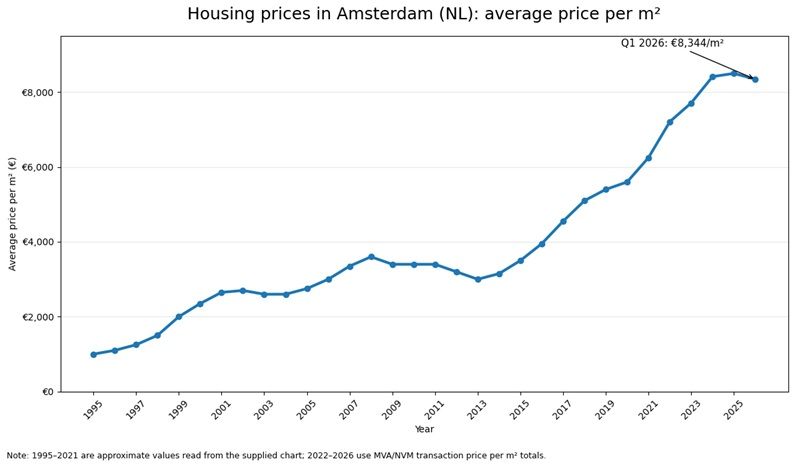
Development of average residential property prices per square meter in Amsterdam from 1995 to Q1 2026, highlighting the sharp rise in prices over the past decade.
The Rental Squeeze: Why Amsterdam Rents Keep Rising
Here is the paradox of 2026: while house price growth cools, the rental market is tighter than ever. Amsterdam remains by far the most expensive rental city in the Netherlands at an average of €28.53 per m² in the free sector — around €2,300–2,400 per month for a typical apartment — with rents up roughly 9% over the past year.
The Affordable Rent Act and the landlord sell-off
The Wet Betaalbare Huur (Affordable Rent Act), introduced in July 2024, extended rent regulation to much of the mid-market segment. Combined with higher taxes on property investors and elevated interest rates, many private landlords have concluded the numbers no longer work — and are selling their properties when tenants leave. In Q1 2026, around 5.5% of all homes listed for sale had previously been private rentals.
The result: well-intentioned regulation has improved conditions for sitting tenants in regulated homes, but the overall pool of rental housing keeps shrinking. The remaining free-sector supply is shifting upmarket — 42% of available rentals now ask over €2,000 per month.
Fierce competition for every listing
A free-sector rental in the Netherlands currently attracts around 31 responses on average and is online for just 18 days. In Amsterdam's regulated segment, popular listings can draw several hundred applicants. Landlords typically require a gross income of three to four times the monthly rent, which puts much of the conventional market out of reach for newcomers without Dutch payslips.
Why demand for furnished mid-term rentals keeps growing
- Long-term rental supply is shrinking as landlords sell
- Hybrid work enables more international placements
- Project-based assignments of 3–12 months are now common
- Newcomers can't meet long-term income/history requirements
- Buying takes months — people need somewhere to land first
What furnished serviced apartments solve
- No furniture purchase or utility setup needed
- Municipal registration (BRP) address included
- Flexible contracts from 2 to 12+ months
- All-inclusive pricing — utilities, internet, service
- Move-in within weeks rather than months
Market insight: peak demand for furnished apartments in Amsterdam falls in August–September (academic year and new contracts) and January–March (corporate relocation season). In these windows, quality apartments are reserved 4–6 weeks ahead — book early to secure your preferred location.
Mortgage Rates in 2026: Higher for Longer
Mortgage rates remain the single biggest force shaping the market. A 10-year fixed mortgage currently averages around 4.2% — compared with barely 1% at the 2021 low point. By long-term historical standards that's not extreme, but the jump has permanently reset what buyers can afford: a household that could borrow around €450,000 in 2022 typically qualifies for substantially less today.
Looking ahead, economists at the major Dutch banks expect rates to stay flat or rise slightly through 2026, with Dutch 10-year government bond yields at their highest level in over two years and the ECB no longer expected to cut. For buyers, the era of cheap money is not coming back soon — and for tenants, higher rates keep would-be buyers in the rental market longer, adding to demand.
Buy-to-let investors, once a major force in Amsterdam, have largely withdrawn: at current rates and under current regulation, rental yields rarely justify new investment.
Supply and Demand: The Shortage Isn't Going Anywhere
Underneath every trend in this article sits the same fundamental problem: the Netherlands is short roughly 400,000 homes, and Amsterdam is the epicentre of that shortage. New construction continues to disappoint — held back by nitrogen rules, grid congestion, scarce building sites and slow permitting — and completions consistently fall short of what population growth requires.
The temporary boost in for-sale supply from landlord sell-offs is expected to fade through 2026 and 2027. When it does, most forecasters expect the market to tighten again — which is precisely why the banks predict price growth re-accelerating to around 4% in 2027.
What This Means for Expats and Corporate Relocations
If you're relocating to Amsterdam in 2026, plan around three realities:
1. The long-term rental market is the hardest it has been in years. Fewer homes, more applicants, and strict income requirements mean a conventional unfurnished rental can take months to secure — often only realistic once you're already living and earning in the Netherlands.
2. Buying is calmer, but slow. With more inventory and modest price growth, 2026 is a more rational year to buy than 2021–2022 was. But between viewing, bidding, financing and notary transfer, expect the process to take several months — you'll need somewhere to live in the meantime.
3. Furnished mid-term rentals have become the standard landing solution. For stays of 2–12 months, furnished serviced apartments in Amsterdam bypass the competitive long-term market entirely: flexible contracts, registration support and all-inclusive pricing, available within weeks. For employers, they remove the housing bottleneck from international hiring.
Outlook 2026–2027: What the Banks Forecast
The three major Dutch banks broadly agree on the direction of travel, differing only in degree:
| Forecaster | 2026 | 2027 |
|---|---|---|
| Rabobank | +3.1% | +4.1% |
| ABN AMRO | +3% | +4% |
| ING | +1.5% | ~+2% |
In short: a breather in 2026 as ex-rental supply works through the market, followed by renewed pressure in 2027 as that supply dries up against an unchanged structural shortage. For the rental market, no forecaster expects meaningful relief — rents are projected to keep rising at 4–7% annually, and demand for corporate and mid-term housing is expected to remain strong as international hiring continues.
Need Flexible Housing in Amsterdam?
City Retreat has offered furnished serviced apartments across Amsterdam since 2012 — with registration support, flexible contracts from 2 months, and all-inclusive pricing for expats and corporate clients.
View Available ApartmentsAmsterdam Property Market 2026: FAQ
What is the average house price in Amsterdam in 2026?
The median transaction price in Amsterdam is around €594,000 in 2026, or roughly €8,400–8,600 per square metre. Prices range from about €9,000–12,000 per m² in the Canal Belt, De Pijp and Oud-Zuid to around €5,000–6,500 per m² in Noord, Nieuw-West and Zuidoost.
Are Amsterdam house prices rising or falling in 2026?
Prices are still rising, but slowly. National forecasts for 2026 range from +1.5% (ING) to about +3% (Rabobank, ABN AMRO), and Amsterdam is growing more slowly than the national average as buyers shift to more affordable surrounding regions. Growth is expected to pick up again to around 4% in 2027.
Why are rents in Amsterdam rising faster than house prices?
Because the supply of rental homes keeps shrinking. The Affordable Rent Act, higher investor taxes and elevated interest rates have pushed many private landlords to sell when tenants move out, while demand from newcomers stays high. In Q1 2026 free-sector rents rose 7.3% year on year — faster than house prices (+5.1%) and inflation (2.1%).
How hard is it to find a rental apartment in Amsterdam in 2026?
Very competitive. A typical free-sector listing attracts around 31 responses and is online for about 18 days, and landlords usually require gross income of 3–4 times the monthly rent. Many newcomers therefore start with a furnished mid-term apartment, which offers flexible contracts and registration support, and search for permanent housing once settled.
Is 2026 a good time to buy a home in Amsterdam?
It's a calmer market than 2021–2022: more inventory, slower price growth and less extreme overbidding. However, mortgage rates around 4% limit borrowing capacity, and homes in Amsterdam still sell roughly 6–7% above asking in about 15 days. If you plan to stay several years, buying in 2026 means entering before the tightening most forecasters expect in 2027.
Navigating the Amsterdam Housing Market in 2026
Amsterdam in 2026 is a market of two speeds: a sales market catching its breath, and a rental market under more pressure than ever. For buyers, conditions are the most rational they've been in five years. For renters and newcomers, planning ahead is everything — secure flexible accommodation first, then take your time finding the right long-term home.
The good news: the market is far more predictable than during the volatile 2021–2023 period. With realistic expectations, early planning and some flexibility on location, finding quality accommodation in Amsterdam in 2026 is absolutely achievable.